



Phone:
+86-15978414719
Publish Time: 2025-12-30 Origin:https://www.hmaluminumsupply.com
In the core materials of energy storage devices such as lithium-ion batteries and sodium-ion batteries, battery aluminum foil plays a crucial role in current collection, conductivity, and encapsulation. Its performance directly affects battery safety, cycle life, and energy density.
Both 1235 and 1100 aluminum foils are 1-series pure aluminum foils (aluminum content ≥99%), and are the mainstream choice for battery aluminum foil. They share the core advantages of pure aluminum materials, meeting the fundamental requirements of batteries for substrate materials:
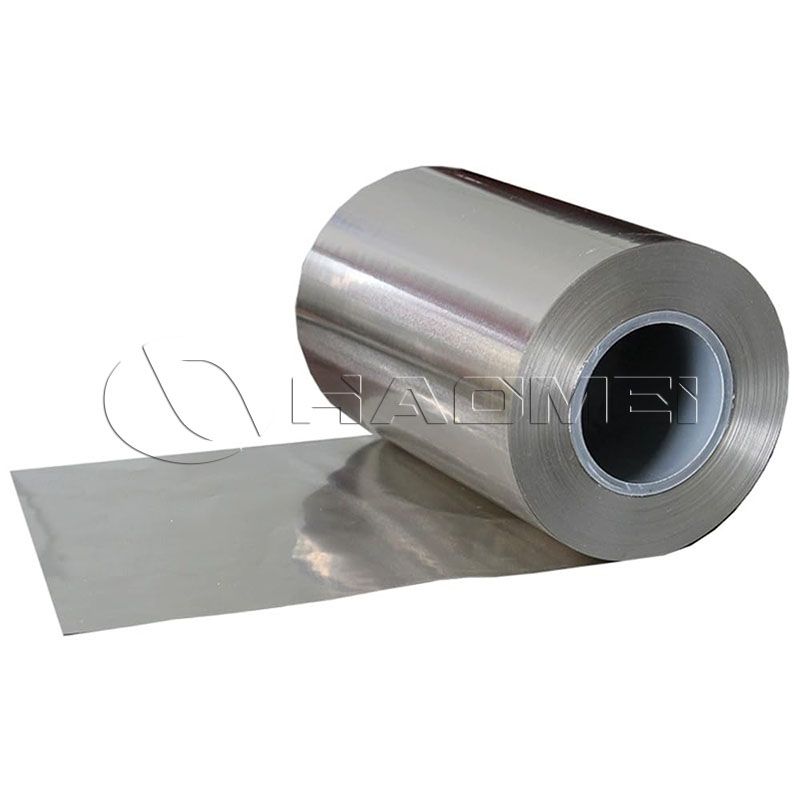
Firstly, excellent conductivity is a core commonality between the two. The low resistivity of pure aluminum ensures efficient current transmission within the battery, reducing energy loss and meeting the core conductivity requirements of battery current collectors.
Secondly, good corrosion resistance allows both to stably adapt to the electrolyte environment inside the battery. They are less prone to chemical reactions during long-term operation, avoiding battery performance degradation due to material corrosion.
Furthermore, both materials meet stringent requirements for precise dimensional control and cleanliness, satisfying stringent requirements for battery aluminum foil regarding thickness variation (typically ≤±3%), plate shape (≤4mm overlap at 2m spacing), and pinholes (≤0.6 pins/㎡). The surfaces are free of obvious oil spots, burrs, and other defects, ensuring smooth subsequent processes such as coating and encapsulation.
In addition, both materials possess excellent formability and weldability, adaptable to the processing needs of different battery casings, and offer lightweight advantages without adding extra load to the battery.
The aluminum content of 1235 aluminum foil is ≥99.35%, with Si and Fe as the core impurity elements, and their total content ≤0.95%. Other trace elements (Cu, Mg, etc.) are controlled within 0.05%, resulting in higher purity and more precise proportions.
1100 aluminum foil, with an aluminum content ≥99.0%, has relatively relaxed restrictions on impurity elements, allowing for Fe content up to 0.7% and Si content up to 0.2%, resulting in higher tolerance for trace impurities and a wider range of compatible raw materials.
This seemingly minor difference in composition directly impacts the core performance of the material: the high-purity formulation of 1235 gives it advantages in corrosion resistance and surface stability, while the compositional tolerance of 1100 allows for more flexible manufacturing processes and greater flexibility in cost control.
In battery manufacturing processes such as coating, slitting, and encapsulation, the tensile strength and elongation of aluminum foil directly affect the risk of breakage. The mechanical properties of the two differ significantly:
1235 aluminum foil (H18 temper), at common thicknesses (12-15μm), achieves a tensile strength of 230-250MPa and an elongation of ≥2.5%. Some high-end models (such as 1235D) can exceed 260MPa in tensile strength, exhibiting more balanced mechanical properties. It is less prone to breakage in high-speed coating and complex molding processes, making it suitable for highly automated production lines.
1100 aluminum foil (H18 temper), at the same thickness, also achieves a tensile strength of ≥230MPa and an elongation of ≥3%, with slightly better elongation performance than 1235. It is more advantageous in scenarios requiring multiple bending and deep drawing, but under extremely high-speed production conditions, its strength stability is slightly inferior to 1235.
1235 aluminum foil, with its high purity and precise composition control, exhibits superior surface dyne stability. After corona treatment, it can stably reach 32-36 Dyn/cm, effectively preventing issues such as missed coating and film detachment during the coating process. It is particularly suitable for applications requiring high surface wetting performance, such as lithium iron phosphate and sodium-ion batteries.
Simultaneously, its extremely low impurity content reduces internal metal debris, dust, and other contaminants, lowering the risk of short circuits and improving the long-term cycle stability of energy storage batteries.
1100 aluminum foil also meets basic coating requirements in terms of surface properties, but its dyne stability is slightly lower than 1235. In the demanding processes of high-end batteries, additional control of the production environment is required. However, its mature production process and high yield make it more cost-effective in applications with moderate performance stability requirements.
The core logic of selection is "scenario suitability + performance priority + cost control." Considering the differences between these two, the following are precise selection suggestions for different scenarios:
High-end energy storage batteries: such as lithium iron phosphate power batteries and sodium-ion batteries. These batteries have extremely high requirements for cycle life (typically ≥2000 cycles) and safety. The high purity and low impurity characteristics of 1235 foil can reduce internal side reactions and improve long-term stability, making it suitable for the long-term use requirements of energy storage scenarios.
High-speed automated production lines: When the coating speed is ≥300m/min, the superior strength and stability of 1235 foil reduces the risk of foil breakage and improves production efficiency, especially suitable for large-scale production in large battery factories.
High-requirement packaging scenarios: such as soft-pack battery casings and irregularly shaped battery packaging. 1235 foil offers a better balance between formability and weldability, ensuring sealing and preventing electrolyte leakage, making it suitable for high-end consumer batteries, medical device batteries, and other scenarios.
Mid-to-low-end consumer batteries: Such as small lithium-ion power banks and toy batteries. These batteries have moderate requirements for performance stability. The elongation properties of 1100 foil meet conventional packaging needs, and the lower cost effectively controls the pricing of end products.
Deep drawing scenarios: Such as cylindrical battery casings and complex-shaped battery current collectors. The slightly better elongation of 1100 foil allows for multiple bending and deep drawing processes, reducing the risk of cracking and breakage during the forming process.
Cost-sensitive projects: When battery production capacity is large and there are no extreme performance requirements, the manufacturing process advantages of 1100 aluminium foil can reduce procurement costs, improving project profit margins while ensuring basic performance.
With the development of dozens of years, we, Haomei Aluminum has solid base to provide clean aluminum material for the high-end applications including lithium-ion battery, lightweight automobile body, 3c products, aluminum brazing and other special uses.