



Phone:
+86-15978414719
Publish Time: 2026-08-25 Origin:https://www.hmaluminumsupply.com
For grid lighting fixtures, the primary material concern is not simply a bright appearance. It is maintained specular reflectance after slitting, forming, assembly, and service. A visually shiny aluminum surface can still produce uneven light distribution, glare, or reduced luminaire efficiency if its reflectance, surface uniformity, and protective treatment are not controlled.
Aluminum mirror sheet is commonly used for louver grids, parabolic reflectors, recessed troffers, linear fixtures, and decorative lighting components. Procurement specifications should define optical performance and processing limits before comparing offers.
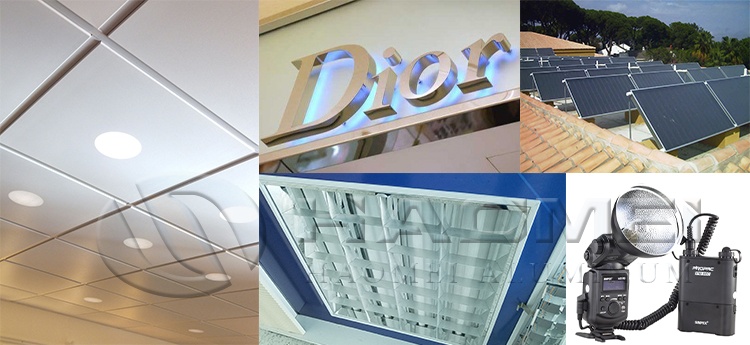
A grid reflector redirects lamp or LED output. High specular reflectance helps direct light downward or into the intended beam pattern, while poor surface consistency creates streaks, dark areas, and uncontrolled glare.
Do not accept "mirror finish" as the only optical requirement. This commercial term does not define measured reflectance, test geometry, coating system, or allowable visual defects.
| Item | Recommended requirement | Why it matters in grid lighting |
|---|---|---|
| Base alloy | 1050, 1060, 1070, or 1100 series for high-formability reflector applications | High-purity aluminum provides good brightness and forming behavior |
| Temper | H14, H16, H18, or agreed soft temper for deep forming | Temper affects springback, flatness, and cracking risk |
| Surface | Mechanically polished, chemically brightened, anodized mirror finish, or coated reflector finish | Surface route determines reflectance stability and corrosion resistance |
| Reflectance | State total and specular reflectance, wavelength range, incident angle, and test method | Prevents comparison of non-equivalent optical data |
| Thickness | Commonly 0.30 mm to 1.20 mm, subject to fixture design | Thin material reduces weight; thicker material improves rigidity |
| Width and flatness | Define coil width, edge condition, camber, wave limits, and cut-length flatness | Controls feeding, stamping, louver alignment, and assembly gaps |
| Protective film | Specify film type, adhesion range, removal condition, and aging period | Prevents handling scratches and adhesive residue |
For visible-light reflector applications, request measured data over the visible spectrum, typically 400 nm to 700 nm. A supplier should state whether the quoted value is total reflectance or specular reflectance. These values are not interchangeable: total reflectance includes diffusely reflected light, while specular reflectance indicates how effectively the surface preserves directional light control.
Use a documented optical test setup. The purchase specification should identify instrument geometry, measurement angle, illuminant or wavelength range, sample orientation, and number of samples. ASTM E903 covers solar absorptance, reflectance, and transmittance measurement using integrating spheres; it may be useful for broader optical characterization, but fixture designers should confirm that the method matches the required visible and directional-reflection performance.
An untreated polished surface can lose brightness through fingerprints, oxidation, cleaning chemicals, and handling abrasion. For indoor grid lighting, anodized or clear-coated reflector material is usually preferred when appearance retention is important.
| Finish type | Strengths | Limitations | Suitable applications |
|---|---|---|---|
| Bright polished aluminum | Lower processing cost, good initial appearance | Lower scratch and corrosion resistance without protection | Protected internal reflectors with limited handling |
| Anodized mirror aluminum | Better surface hardness, improved oxidation resistance, stable appearance | Higher cost; forming must be evaluated to avoid crazing | Office grids, retail luminaires, architectural fixtures |
| Clear-coated mirror aluminum | Fingerprint resistance and added chemical protection | Coating can reduce specular reflection if not optimized | High-touch assembly processes and decorative luminaires |
| Embossed reflective aluminum | Hides minor handling marks, adds texture | Reduces directional reflection and can alter beam control | Decorative lighting, diffusion-oriented panels |
For precision parabolic louver grids, smooth anodized reflector material generally provides better directional performance than embossed material. Embossed surfaces can be appropriate where visual texture or glare softening is more important than maximum beam control.
The material standard should be selected according to product form and market. ASTM B209 covers aluminum and aluminum-alloy sheet and plate. In European supply chains, EN 573-3 addresses chemical composition, while EN 485-2 provides mechanical-property requirements for wrought aluminum and aluminum-alloy sheet, strip, and plate. For prepainted or coil-coated aluminum, EN 1396 is relevant to coated aluminum products used in general applications.
These standards do not automatically guarantee lighting-grade optical performance. Reflectance, coating quality, protective film, and visual acceptance criteria must remain separate contractual requirements.
Request a pre-production sample from the same finish system, alloy, temper, and thickness proposed for production. Evaluate it after the actual stamping, bending, punching, and cleaning sequence. A flat sample alone cannot predict surface damage at punched corners, bend radii, or louver intersections.
Verify coil or cut-length identification, alloy, temper, thickness, width, and net weight against the certificate of conformity.
Measure thickness at the center and both edges. Agree the permissible tolerance before ordering.
Inspect both sides under controlled lighting for roll marks, dents, scratches, coating streaks, pinholes, stains, and film bubbles.
Test reflectance on representative samples from the beginning, middle, and end of a coil when optical uniformity is critical.
Check flatness, camber, edge wave, and coil set before automated feeding.
Confirm protective-film peel performance after storage at the expected warehouse temperature and duration.
Run forming trials for cracking, whitening, orange peel, surface scuffing, and coating delamination.
Retain approved limit samples for visual comparison during future deliveries.
For lighting assemblies sold as complete luminaires, material compliance is only one part of product compliance. IEC 60598 series requirements apply to luminaires, while photobiological safety evaluations may involve IEC 62471 depending on the lamp or LED source and product design. Reflector aluminum can improve optical control, but it does not replace luminaire-level electrical, thermal, photometric, or safety testing.
A practical order document should include alloy, temper, thickness tolerance, finish construction, minimum measured reflectance, test conditions, visual defect limits, protective-film requirements, packaging method, and acceptance sampling plan. This prevents a low initial material price from becoming a higher cost through stamping loss, inconsistent light output, or rejected fixture assemblies.
With the development of dozens of years, we, Haomei Aluminum has solid base to provide clean aluminum material for the high-end applications including lithium-ion battery, lightweight automobile body, 3c products, aluminum brazing and other special uses.